An Open-Hearted Meditation

Put your ear down close to your soul and listen hard.” – Anne Sexton

My heart absorbs a lot in a day. That is to say that as I traverse my days, bouncing between to-do’s and must have dones, I collect a lot of nuggets that I store away in my heart as if it is a four-chambered storage cabinet.

– The note of trepidation from my kids as they start a new activity.

– An observation about a colleague who appears to be wrestling with anxiety.

– The feeling I shoulder when coming alongside a friend’s worry.

At some point I have to empty my heart storage cabinet so I can carry on and pick up new things, about myself or others. I think that’s why I love this breathing/heart meditation that I originally picked up from Deepak Chopra almost twelve years ago. [With all due respect to Deepak Chopra, this may no longer resemble the meditation as he taught it so please forgive any blips in the flow.]

Sitting with your eyes closed, feel your heart. Notice how it is feeling. Is it heavy? It is happily skipping a beat? Is it calm and serene?

Now take a deep breath into the front of your heart. Feel your chest expand. Feel that front wall where your heart meets the world.

Next breathe into the back of your heart. Allow the solidity and strength of your back to make room for the heart.

Take a deep breath and direct it to the top of the heart. Does it feel like there is a lid on your heart that can crack ajar to give the heart a little room to expand?

Now send your next inhale to the bottom of your heart. Breathe through all that might have settled there and benefit from some air to get moving.

The next breath is for the sides of the heart. As you feel the sides of your heart lengthen with the inhale, sit a little taller to feel your whole ribcage expand.

And finally, breathe into the whole heart. Notice how it is feeling. Is it the same as when you started? Or have you uncovered something tucked away there?

(featured photo from Pexels)
The Unified Theory of Breathing

Sometimes it’s okay if the only thing you remembered to do today was breathe.” – unknown

Long before I learned to meditate, I learned a breath practice while climbing mountains. Guides call it the “pressure breath” and it involves intentionally breathing out all the air in our lungs so we can take a full inhale. They explained the reason for the pressure breath because we often don’t exhale all the air in the lungs. Without consciously thinking about it, our bodies can short cut a full exhalation. But at altitude, the air is thinner so we need a full inhale.

If you climb to Camp Muir on at 10,000 feet on Mt. Rainier where I learned the practice, you will be taking in only 2/3 the amount of oxygen that you would at sea-level. For every 1,000 feet you climb, it decreases by about 3% so at 18,200 feet (my personal high point), it is about 45% of the oxygen at sea-level.

So the pressure breath helps to counter the effect of thinner air by forcing a breath that takes in more air and therefore more oxygen. (For anyone who is interested, the reason there’s less oxygen is that there’s less pressure at altitude so that there are fewer oxygen molecules in the same volume of air).

Twenty years after I learned to pressure breathe on a mountain, I’ve stumbled on the science of other reasons to fully exhale. It feels like a moment of a unified theory – understanding why something I learned in one context is so healthy for many other reasons.

The book Breath: The New Science of a Lost Art by James Nestor inspires me to try to reform everything about my breathing. It is so well-written, researched and told through personal anecdotes and other living examples. In his chapter, Exhale, he cites two studies that set out to measure lung capacity as it related to longevity. They both found “that the greatest indicator of life span wasn’t genetics, diet, or the amount of daily exercise, as many had suspected. It was lung capacity.”

And the way to bigger lung capacity? James Nestor provides a couple of different examples but they involve extending the range of the diaphragm (the typical adult only uses about 10% of the range) by practicing exhaling fully. In short, Nestor said we need to take as few breaths as we can to sustain our metabolic rate. Take fewer breaths and get more oxygen and then the diaphragm moves up and down and helps with circulation and moving lymph fluid. The perfect breath is 5-6 breaths/minute. Cite the Ava Maria or Om Mani Padme Om or the Sa Ta Ma Na (Kundalini Chant) – they all take about the same amount of time of 5.5 seconds.

Adding to this science, I also recently heard Ten Percent Happier podcast with therapist and author, Deb Dana. In it she explained poly-vagal theory and the three states for our nervous system:  ventral state which is calm and regulated, sympathetic which the fight or flight response and dorsal which is when the nervous system has been so overstimulated that it shuts down. And while all three states work to help us navigate particular circumstances of life. But when we need to get back to a ventral or calm and regulated space, there are breathing practices that help us do so. A longer exhale is one of them.

So there it is – the unified theory of the full exhale. I thought living at sea-level made pressure breathing unnecessary for me. Until I realized that I’ve been doing it in different ways all this time – the exasperated sigh, the mindful breath practices and everything in-between that continues to teach me that the things we learn in one context continue to be effective everywhere else, helping me climb all sorts of metaphorical mountains one step at a time.

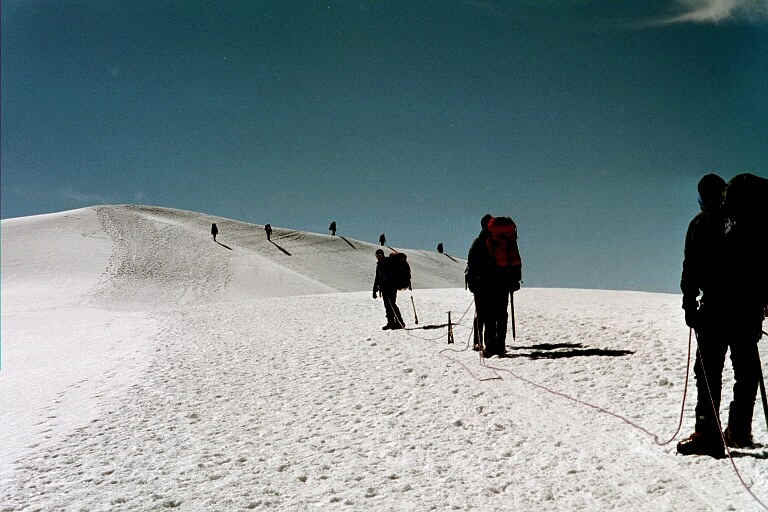
(featured photo is mine of a team of climbers leaving the summit of Mt. Ixtacchuatl, 17,600 feet)

Dare to Dream

Whatever you can do, or dream you can, begin it. Boldness has genius, power and magic in it.” – Johann Wolfgang von Goethe

I had three days this past week where both of my kids were at school/daycare. Do you know what I did? Nothing. Well, not nothing exactly.

I allowed myself to believe that we could start to find a regular routine for school and work.

I relaxed that core part of my body that has been holding me upright for 18 months as I’ve been afraid that if I didn’t stand tall my little family would crumble.

I breathed in to the space created by being able to give up the jobs of teacher, school janitor, lunch lady, PE coach, and school social coordinator for a 6-year-old.

I dared to dream that I might have some energy left for me to grow as we return to more normal days.

Like famed psychiatrist and author Dr. Scott Peck answered when asked how he gets so much done – “it’s because I spend two hours a day doing nothing.” I suspect doing nothing looks different for every person – meditating, reading, praying, playing but out of it comes a renewed spirit.

I think of all the hard times I’ve gone through – divorce, grief, sickness, this pandemic and how there’s an inflection point where all of a sudden I realize that I’m through it. Not that I believe that this pandemic is done, especially because my kids are not yet eligible to be vaccinated and not the day-to-day was bad. It’s just that I was holding back a little reserve in order to gut it out.

When I first started mountain climbing, a guide taught me how to pressure breathe. To breathe out so forcefully that all the stale air in the lungs is expelled and it is possible to take a full inhale. The last three days feel like one big pressure breath, an exhale so powerful that I feel invigorated by all the fresh air I was able to breathe in.

And all that extra energy reminded me that it’s been a long time since I believed that I could really dream about what else is possible in my life. That’s what I did for the last 3 days – dreamed big, audacious dreams.