“We have not inherited the earth from our parents; we have borrowed it from our children.” – Wendell Berry
A while ago we were driving and saw litter by the side of the freeway. Mr. D said, “It’s not healthy for the moon to eat.” It started a rousing discussion of not only what planet we live on but also Earth sustainability.
A lot of the climate change messaging these days doesn’t seem to resonate with kids. First, it’s rife with fear and disgust – like humans strangling the planet because they are short-sighted and selfish. I’m not sure that resonates with grown-ups but I know for certain kids can’t grok the cynicism.
Second, they have a sense that grown-ups don’t know what to do about it so it feels too big for kids to take on.
Third, they are just developing their altruism muscles so giving up things when other people are not lands as unfair.
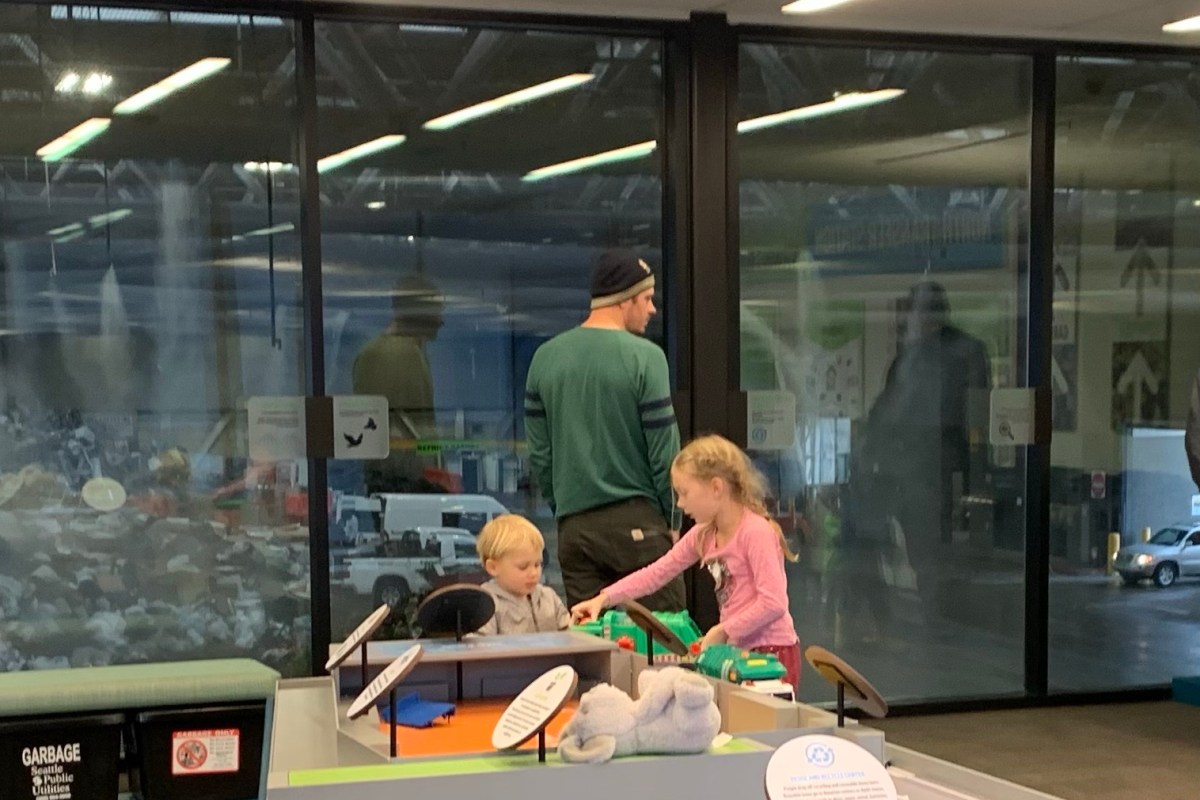
Fortunately, Seattle has a great recycling and composting program. In the winter, we’ve spent a lot of time at the dump (the transfer station) watching how it works and playing with the educational models (see pictures here). Inculcating some sustainability habits to go hand-in-hand, seemed to me like a good next step.
After trial and error, some climate change for kids books, and thinking, here are some of the things I’ve come up with to teach my kids:
One in, one out: We participate in hand-me down chains for toys, books, and clothes. We try to give away at least one thing for everything we get. I can’t claim we do this every time – but we try.
Involve them: I reuse a lot of containers – like hand soap. They love participating in refilling our containers.
Full life cycle: We grow strawberries, try to grow peas and pumpkins, visit pumpkin farms, and give away our plum crop to people who are food insecure. Even though we live in a city and are disconnected from where our food comes from, I try to connect them to the bounty of the Earth when possible.
Teach them skills: Things break and need maintenance and there are a lot of skills to repair and reuse things instead of just discarding them. I’m not much of a seamstress but I do know my way around drills, saws, caulk, and glue. Seeing that we can not only fix things but also make them better.
Selling our stuff and buying second hand: We have a great second hand kids shop in our neighborhood that makes it possible to sell what we don’t give away – and buy at the same store.
Don’t get me wrong, I’m not trying to oversell what we are doing. They are small efforts and I’m far from consistent and perfect on these things. But these things are doable and sustainable for us. They counterbalance the messages of judgment and fear that leave us feeling helpless. If nothing else, it convinces my kids that they can do something to help. And believing that might just make a difference.
 Surprised By Joy
This is perfect, Wynne! Bite-sized and kid-friendly. I tried to do most of these with my son when he was a child. Now, at 30, he is an industrial designer creating products from reused and recycled materials. There is much I look back on now and wish I’d done differently, but this is one I believe I got right. Thank you, as always. ❤️
LikeLiked by 5 people
Oh, I can’t tell you how helpful it is to hear this from your perspective, Natalie. It is so hard to tell whether we are getting it wrong or right in the moment. So cool that your son is an industrial designer! Awesome!
LikeLike
great initiatives and practices that you’ve put in place with them, at a practical level, and something tangible that they can understand. action is the next step to understanding, and they are doing this.
LikeLiked by 5 people
action is the next step to understanding — what a great phrase, Beth! Thank you!
LikeLiked by 1 person
I love the simplicity of “one in, one out” and your beautiful, thoughtful introduction of interdependency to the kids. Including an up close visit to the dump/transfer station to see what happens once recycling items leave your home. So good. 🥰
LikeLiked by 3 people
Ah yes, our time at the dump…never thought I’d be spending quality time there but it is instructive!! Thanks, my friend!! 🙂 ❤
LikeLiked by 1 person
🥰🥰🥰
LikeLiked by 1 person
An excellent, excellent, super important ost, Wynne. Thanks for providing several useful, constructive suggestions for people to be part of the solution we so desperately need.
LikeLiked by 4 people
Thank you, Jane!
LikeLiked by 1 person
I love all these efforts! We need to all have a sense of wonder and awe for our natural world and our planet, and it looks like you’re doing that. When we love our world we want to do what’s best for it.
The fear approach hasn’t been working. The doomsday messages that we’ve been hearing for decades has rung false, because we haven’t experienced the cataclysmic episodes that the Hollywood movies have portrayed will happen,so we dismiss the fear mongering as untrue.
We need to shift our thoughts to being loving caretakers of our planet, to be able to stand up to the greedy industrialist capitalists!
What you’re doing may feel small, but it is actually huge, because you are raising loving people who will want to be stewards. They will become the leaders of tomorrow, so infusing them with a lot of love will give them the tools they need.
LikeLiked by 5 people
Oh, this comment resonates with me on so many levels, Tamara. Thank you for adding your perspective and encouragement – it really helps. It really feels like love of our planet should work better than fear and argument so I’m glad you chimed in!
LikeLiked by 1 person
Absolutely! Coincidentally I’m having an environmentally friendly post coming out on Saturday morning!
LikeLike
These are great ideas Wynne! And I agree about the climate messaging – I struggle with those same issues now as an adult!
LikeLiked by 3 people
Right? It feels almost paralyzing! Thanks, Todd!
LikeLiked by 1 person
This is great, Wynne! I think you’re right that the doom and gloom has outlived it’s usefulness and it’s more helpful to look forward to the type of planet we want to leave behind for future generations.
LikeLiked by 3 people
doom and gloom has outlived its usefulness — I love that phrase, Erin! Yes!
LikeLiked by 1 person
I love hearing that kids aren’t drawn to that narrative. It gives me hope that your kids’ generation will be more proactive, especially when being raised by parents like you. 🥰
LikeLiked by 1 person
Such thoughtful ways to involve the kids. My favorite is one in one out. (Not only a fabulous sustainability model, but had I adopted that it would have made moving so much easier.)
LikeLiked by 3 people
Yes – moving and many more things. Thanks, Michael! Here’s to one in, one out!
LikeLiked by 1 person
Little by little… it makes a big difference! Thanks for sharing some of the many ways we can return what we borrowed but in better shape for our children.
LikeLiked by 3 people
“Little by little… it makes a big difference!” Love that, Grant! Thanks for your encouragement!
LikeLiked by 1 person
All great ways to teach and include your kids in the process of problem solving. You are such a fabulous mama. 💕
LikeLiked by 3 people
Some days be easier than others… 🙂 Thank you, Alegria! ❤ ❤ ❤
LikeLiked by 1 person
What great lessons to teach your kids. Yes, I miss the PNW and how easy it is to grow vegetables and strawberries. There’s nothing like a garden to help your children understand how important our planet is.
LikeLiked by 3 people
You are so right that is such a gift to be able to grow things. And as you highlight so well from your farmer’s market – taste great too!! Thanks, Elizabeth!
LikeLiked by 1 person
I haven’t found the knack of growing vegetables in Palm Springs or Scottsdale. I’ve tried!
LikeLiked by 1 person
It is fantastic how you involve your children in these endeavors. The things you list were important to us as parents, but sometimes we were a bit guilty of “telling” our son these things instead of involving him in the processes. We’re trying to be more aware of that with the grandbabies.
LikeLiked by 3 people
So funny that you said that, Rose. I was thinking that as I typed the part about teaching them how to repair things. Oh, it takes so much more patience! There is a real temptation to just do it myself. I’m trying to pace myself.
LikeLiked by 1 person
If nothing else, it convinces my kids that they can do something to help.
That’s the reality of it. Smart thinking with your kids.
LikeLiked by 2 people
Thanks, Ally!
LikeLike
Good job, Wynne. You know, I tried the “one in, one out” approach, but I have a couple of hoarders in the house, and the approach only works for me. At least something, Right?
LikeLiked by 2 people
At least that’s something — exactly right, Edward. My kids are hoarders too – it’s a tough fight. 🙂
LikeLiked by 1 person
It definitely is.
LikeLike
Good job Mom! Keep-on-keeping on teaching your little ones these sustainability standards Wynne so their children someday will hopefully inherit a better world than the one we’ve created.
LikeLiked by 3 people
Let’s hope! Thanks for the encouragement, Fred!
LikeLike
I love this, Wynne, and I think you’re teaching your kids perfect lessons that they can understand and act on at this stage of their lives. If everyone did just a few of those things consistently, it would make a big difference. Spreading that simple message is why I started my blog 5 years ago and it’s something I still believe in. And, over time, those small changes snowball into bigger changes.
LikeLiked by 3 people
I thought of you when I was writing this post, Michelle! Yes, it’s such a positive message of what we CAN do. I love your approach!!
LikeLiked by 1 person
These are all great ideas, Wynne. The best teachers lead by example, and that’s what you’re doing. It’s also wise to involve them the way you are.
LikeLiked by 3 people
Thank you, Pete. You do a lot of great leadership by example. I appreciate your encouragment!
LikeLiked by 1 person
One in one out is a great lesson. Glad your family is taking care of the planet in Seattle.
LikeLiked by 3 people
Thanks, Rebecca. It’s a gating factor at the very least! Appreciate your kind words!
LikeLiked by 1 person
This is amazing and so inspiring, Wynne. Taking notes of all these great ideas.
It’s interesting to think about how messages, such as those around climate change, resonate or don’t resonate with kids. I like that you are finding ways to make them relevant in a tangible and actionable way for your kids! 💕
LikeLiked by 1 person
Thank you, Ab! I find it fascinating to see what resonates (or doesn’t) as well. Hope you all have a great weekend!
LikeLiked by 1 person
Much appreciated, Wynne. Some people do turn away from inelegantly phrased and scary messages, some because their favored new source is gaslighting them, and some even when the messages are more easily consumed. Some for other reasons, too.
The truth of our climate, present and future, is that it is requires the best of our efforts and more, of course, no matter the method of messaging.
Sure sounds to me like you are doing your part and training your kids to take the baton from your hands in our endless relay race. Thank you for raising the issue.
LikeLiked by 2 people
Our endless relay race. Well said, Dr. Stein! Thank you!
LikeLike
Imagine our surprise upon moving to South Dakota in 2018 and learning that our apartment complex had no recycling available. This, after 2+ decades in the very environmentally friendly PNW. Even when we bought our house, we could only recycle glass and plastic – no paper whatsoever. It’s better in Wisconsin, but whenever my parents visit, they’re astounded we can still get plastic bags in the grocery store.
LikeLiked by 3 people
Oh yes — isn’t that fascinating? I’m amazed at that when we leave the city. Even Whidbey Island doesn’t recycle cardboard. I get this strange feeling I’m doing something wrong when I throw something away that I’d recycle at home! 🙂
LikeLiked by 1 person
I know! We always felt so guilty!
LikeLike
WOW! That’s impressive, it is challenging enough raising kids in a material world. Many years ago I took a professional development class called, “Where is Away?” and we talked about all of these issues and visited all sorts of places that recycled and managed the waste produced by the Chicago metro area some 6-7 million people. It’s mind boggling how much we discard while many of us don’t think about it at all. Maybe Miss O and Mr. D will be part of the generation that says NO, and works to fix it. Looking forward to Saturday’s sign. Peace.
LikeLiked by 3 people
Where is Away? What a name, Clay! Thanks for sharing this!
LikeLiked by 1 person
I love your list of activities that you and your kids are doing. The news of climate change can be overwhelming, but taking action can help. Little actions can build upon each other. I think you’re being a fantastic role model for your kids by doing — and encouraging — these activities. 🌞
LikeLiked by 3 people
You said it perfect – taking action can help that feeling of overwhelm. Thank you for your kind words, Dave!
LikeLiked by 1 person
You’re putting words and beliefs in to action Wynne. Your children will remember 👌
LikeLiked by 3 people
Thank you, Margaret! ❤
LikeLiked by 1 person
Beautifully written
LikeLiked by 2 people
Thank you, Sunshine!
LikeLiked by 1 person
I liked that you used the word ‘grok’, I don’t think I have ever heard this word.
I’m afraid it’s took late to “save” the planet, we just can mitigate some of the damage. Every little bit helps though.
LikeLiked by 3 people
Ha, ha – thank you, Justin. I think I learned that word in a programming class decades ago. I tried to find a better word but it just stuck. Thanks for reading! 🙂
LikeLike
I believe this is the best way to become environmental friendly. Well done Wynne!
LikeLiked by 2 people
Thank you, Cristiana!
LikeLike
I love your list. You are teaching your children to think about how they can make a difference, not just do it all by rote. Knowing Mr D and Miss O, I’m sure they’re coming up with ideas of their own, too. 🙂
LikeLike
“One in, one out” is good – but does the incoming stuff come from the discarded “out” pile or from a shop? Just curious as I feel we all put out stuff for someone else to recycle..so we can carry on buying our nice new stuff
LikeLike