Curiosity and Judgment

There is a wisdom of the head…and a wisdom of the heart.” – Charles Dickens

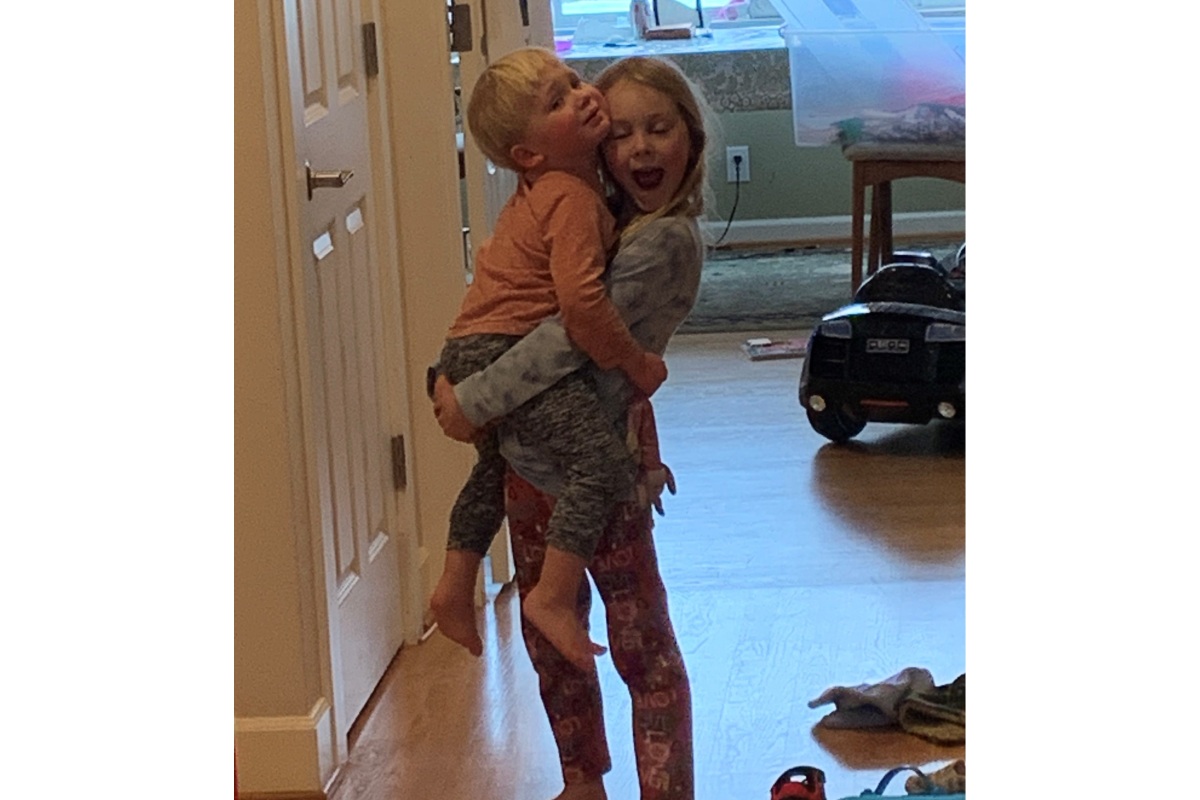
I came around the corner the other day to find my 6-year-old daughter lifting her 2-year-old brother and telling him, “If you want down, say ‘Down please.’“ Because there’s only about a 10 pound difference in weight between the two of them, it looked a little precarious.

The moment I gave birth to my second child, my oldest all of a sudden seemed so grown up. But every time I think of her as the “One who should know better” or my son as the “One who is too young to stick up for himself” I suffer from that lapse into judgment.

My meditation teacher once led a beautiful meditation about gratitude. In it she suggested that there are some things we can’t feel at the same time – like gratitude and greed. I think another pairing for me is judgment and curiosity. When I’m sitting in judgment, my curiosity is not available to me.

Of course my brain is just trying to make a fast assessment about what I need to do in a situation and so judgment serves the purpose of quick analysis. And my brain doesn’t only do this my kids but jumps to scan a homeless person for danger or to dismiss an apparently wealthy person as too busy to help.

Once I get past that quick assessment to check if anyone is in danger, I can remember to breathe in curiosity and compassion. Those two tools that almost always come up with a better and more creative response to whatever situation I find myself in.

 My compassion tells me my daughter is trying to figure out how to use her strength and knowledge to help her brother and that my son likes the attention most of the time. Once I figure out no one is getting hurt, I can sidestep my judgment and let them figure it out.

In my daughter’s quest to teach her brother some manners, she hasn’t quite thought to ask if he would like to be picked up before holding him hostage until he asks politely to get down. I’m curious how long it’s going to be until he figures that out.

Celebrating the Messy Middle

Half the trouble in life comes from pretending there isn’t any.” – Edith Wharton

On Monday, I was practicing a short mindfulness break in the middle of the day to create more awareness of the middle of my life as I wrote in this post. What I noticed was that my day was kinda awful.

On the carpool to school, our neighbor and my daughter’s best friend broke the news that in three months they are moving 1200 miles away.

I’d just set aside all the gratitude and grief that arose as I thought of this big change in my daughter’s first real friendship so that I could work. Then the phone rang and it was my son’s daycare and they’d had an outbreak of Hand, Foot and Mouth Disease and needed me to come pick him up right away and get a note from the doctor before he could return.

I canceled all the rest of my work appointments for the day while I was driving to school to retrieve him, scheduled a doctors appointment for him in the afternoon. Then I asked the neighbors if my daughter could stay with them after school until I returned from the doctor which brought another wistful realization of how much I’ll miss them when they move in three months.

In short, the day was reactive, unsettling and bumpy. As I mindfully checked in with this, I had to chuckle because it reminded me of something I learned from Buddhist nun Pema Chödrön. That meditation and mindfulness are not ways to always be feeling good – in fact, it often brings more irritation because we are aware.

Aware and irritated by it fit how I felt during that check-in perfectly. However, the awareness brought the ability to move through it instead of just locking it up in a box. And that is always a gift I appreciate because I learn that I can handle it. I’ve come to think of meditation as my way of irrigating the irritations so I can flow past.

Sitting with this, I could touch the powerfully poignant moment when my daughter’s first friendship changed. More than that, I was able to notice it before my optimism overwrote it with dreams of new neighbors, a new carpool and the next friend. And I suppose that’s exactly the point of focusing the spotlight of awareness.

It seems perfectly fitting to write about this in the middle of the week. 🙂

(featured photo from Pexels)

In The Middle

The longer I live, the more beautiful life becomes.” – Frank Lloyd Wright

A little while ago my 6-year-old daughter went to a friend’s house to watch a movie. When she came home that night and for the couple weeks afterwards, she was so much more solicitous of me. “Mom, do you want a glass of water?” or “I’m sorry you banged your hand.” So I dug deeper into the storyline of the Netflix family movie Over the Moon. Not surprisingly, it’s about a little girl whose mom died from cancer.

I don’t want my kids operating from a space of worry about me. But I was fascinated about the noticeable change of behavior. It suggested how much our awareness is influenced by our focus.

So I was listening carefully when I heard author Susan Cain describe the research of Dr. Laura Carstensen on Brené Brown’s Unlocking Us podcast. Dr. Carstensen is a professor of psychology at Stanford specializing in the psychology of older people. Here’s Susan Cain’s description of the research:

“[The] elderly tend to be happier and more full of gratitude, more invested in depth relationships, more prone to states of well-being. She has linked all of that with the fact… not as we might think that we get older and have acquired all this wisdom from the years we’ve lived. It has nothing to do with that, it only has to do with the fact that when you are older you have a sense of life’s fragility. You know it’s coming to an end.

“Younger people who for other reasons are in fragile situations [also exhibit this]. She studied students in Hong Kong who were worried about Chinese rule at the end of the 20th century. They have the exact same psychological profile as older people did. Because the constant was the fragility.”

Susan Cain describing the research of Dr. Laura Carstensen

Since at 52-years-old I’m closer to the middle of my life (hopefully) rather than the end, it begs the question of how to cultivate an appreciation for relationships, health and the good times. Especially to enjoy them without the sense of fragility that I understand but don’t quite viscerally get yet.

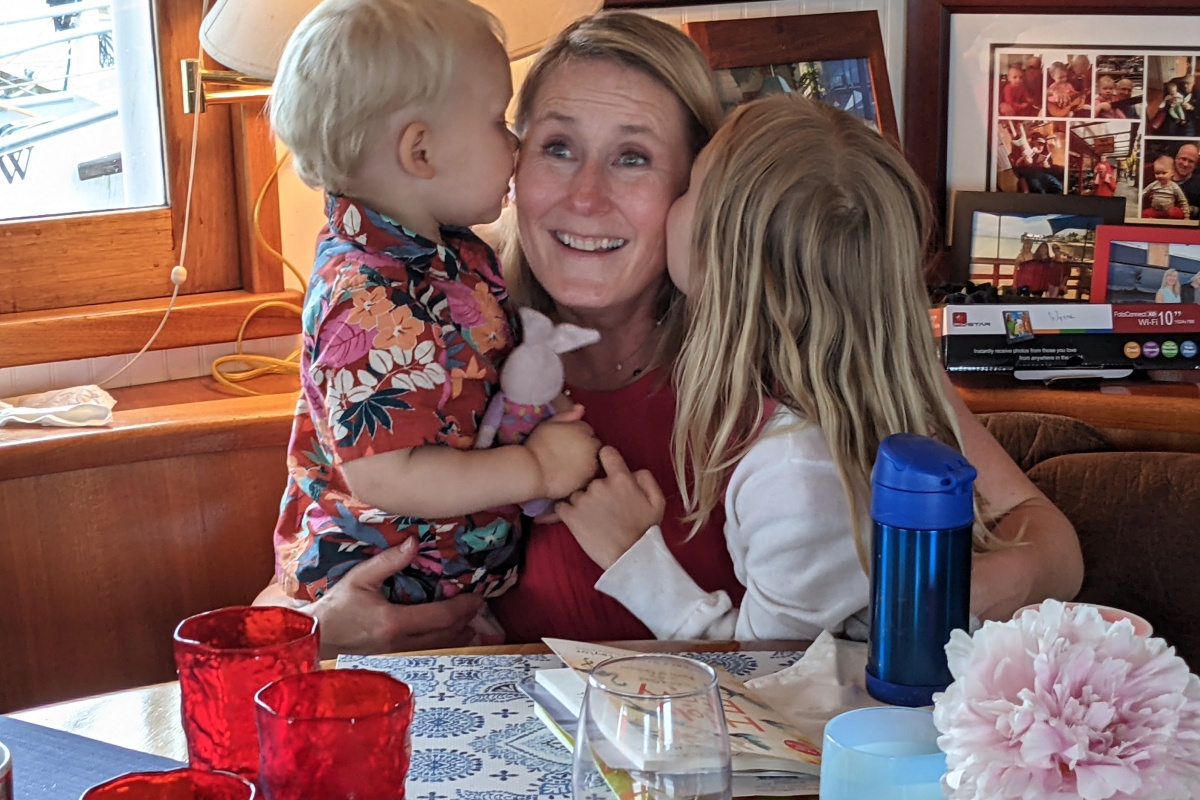
This made me ponder the nature of the middle and I realize I couldn’t name a middle of something that I really savored – the middle of the day, the middle of a meal, the middle of a relationship, the middle of a project, the middle of my body. (That is, other than being in the middle of my children, as shown in the featured photo.) Especially when it comes to projects (and maybe even days), I’m always in a rush to get to the end so that I can celebrate and then start a new one.

Someone wisely pointed out that we can’t remember things we don’t pay attention to. So I’ve started taking a brief pause in the middle of the day to just notice how things are going. It’s a small practice that I hope will help me appreciate the middle of my life more.

I was thinking about what to say to my daughter about the movie and death when one night she said, “I’d be kinda sad to die but also a little interested. I have to see the way the rest of my life works out and I’d miss you. But it’ll probably be your turn first.” And then all the solicitousness was gone. Which is fine. I want my kids’ memories and mine to be defined by not what we worry about but what we pay attention to.

What about you? Do you rush right past the middle or do you have a way to mark the middle of a journey?

The Best Kept Secrets are Boring

I find meditation hard to write about. Even as a cornerstone of my life and day, it seems so hard to describe sitting still in an engaging manner. So I’m feeling gratified that I managed to write a post about meditation for my Pointless Overthinking post this week. Here’s how it starts:

At a meditation retreat I attended a few years ago, the leader off-handedly told a story about a moment when she was doing a large group meditation practice with the renowned meditation teacher Jack Kornfield.  The six of us sitting around laughed politely at her description of 500 people doing a slow walking meditation practice at the Seattle Center while a group of kids right next to them were playing a dodge ball game so that the meditators were occasionally getting beaned by rubber balls. But the truth of the matter is that meditation stories aren’t very interesting – even to other meditators.

More of this post at Pointless Overthinking

Gifts

The two most important days in your life are the day you are born and the day you find out why.” – Mark Twain

I saw the results of a new survey that found that kids will watch a favorite movie on average 244 times. It certainly feels like we are well on our way to that number of viewings of Encanto, one of the more recent releases from Disney.

Which isn’t an entirely bad thing. In addition to some great songs written by Lin Manuel Miranda, it’s a really compelling story about a family of gifted individuals. It’s centered around the story told by the grandmother that they were granted a miracle which has manifested through a candle that always burns, a magical house where they all live and gifts that they are bestowed at a certain age.

One makes food that heals other people, another controls the weather, one sister is incredibly strong while the other sister is beautiful and graceful. But the character at the center of the movie didn’t get a gift when it was her turn.

My 6-year-old daughter and I have had great conversations about the premise of the movie. About what it would feel like to be the one person in a family of talented people who didn’t get her gift. And also does everyone in this world get a gift? Finally, a lot of discussion of that fact that most gifts are given over time, not at a ceremony at age 7, 8 or 9 but through a lot of hard work and practice.

But it certainly has made me think of my own gifts – whether I can recognize them or even value them. I grew up with a natural talent for mathematics. I never thought you had to take notes in a math class because it always just made sense to me and that carried all the way through all the upper level math I took in college.

However I’m not all that crazy about that gift now. 😊 What’s the practical application of that? In fact, it wasn’t until Swinged Cat admitted that he sees in rhyme that I remembered my gift. Sure it was the foundation of my computer consulting career that now supports my family but it isn’t all that warm and sexy.

But I have some traits that I’ve worked hard to develop. I’m a good and empathetic listener. Hiking, mountain climbing and parenting have helped me build a lot of endurance. Meditation has given me the gift of patience and calm. Do any of those things I cultivated count?

Here’s where I came down on this when talking to my daughter:

Some gifts are natural and others you will have to work harder for.

We will only see the gifts we’ve been given if we have the confidence to look and the commitment to grow them.

Whatever they are, when we use those gifts on behalf of other people it makes them matter the most.

When we can combine our gifts with the direction of the Divine, it magnifies their usefulness many times over.

My mathematical brain tells me we have about 111 more times watching Encanto to go. There are many more thought-provoking themes like being authentic, family pressure and being more than your gift so for anyone who hasn’t seen it, I’d say it’s worth watching at least once.

How about you? What are your gifts?

(featured photo from Pexels)

Today

When you realize how perfect everything is, you will tilt your head back and laugh at the sky.” – Buddha

Potty training is really getting my goat. A month in and we mostly have successes but the failures are memorable! It’s unpredictable, impossible for me to control (which seems to be most of the battle) and creates a lot of laundry.

I catch myself thinking, “Pretty soon we are going to be through this and then life will be great.”

Which I think will be true. Especially if I remember how to savor today.

Because I think is how we wish our lives away and as a parent, how I could wish my kids’ childhood away. Waiting for the thing we don’t like to stop and THEN we’ll be good. Or waiting to lose 10 pounds, reach a milestone or be better at meditating – anything I reflexively put between myself and my experience.

Returning to today – we still laugh and learn every day, and I still love my kids to pieces every day. Yep, every time I leave, I just need to come back from my visit to the future and love today. And also I need to buy more laundry detergent.

Crossing the Chasm

Beautiful days do not come to you, you must walk towards them.” – Rumi

Yesterday was the first day that my daughter could be in school without a mask on. I found it to be a trepidatious experience. As a single, working parent, one of my biggest concerns is for school to be able to continue in-person. If I had to send my child in a full haz-mat suit, I would happily comply.

But broader than that, now that our state mask mandate has ended, is the question of whether I would continue to wear a mask when going into a store or resume activities like an in-person meditation class now that we seem to be transitioning to endemic mode from pandemic mode.

I’m not an epidemiologist so I don’t have an authoritative answer on mask wearing so I’m happy to follow their advice. But some of this return to normalcy feels like taking a big step to cross over the chasm.

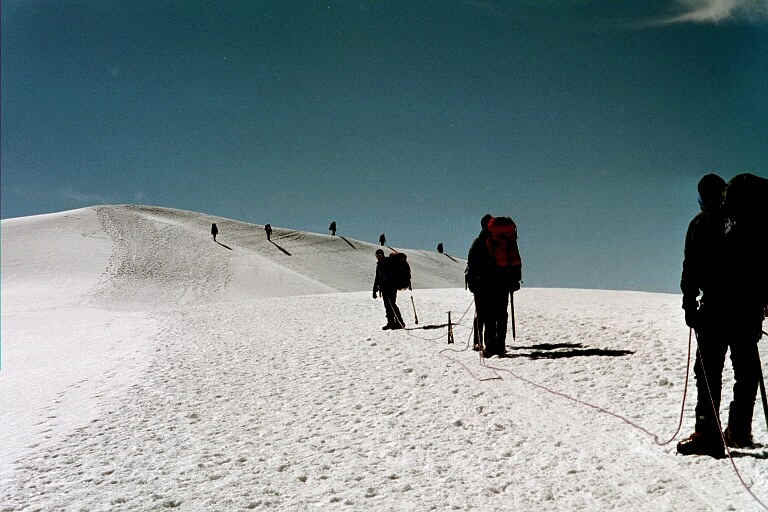
Crossing over the chasm makes me think of some of the scariest things I’ve had to jump over or traverse when I was climbing mountains – like crevasses on Mt. Rainier. In most cases, I was lucky enough to have traversed them the first time going up the mountain in the dark. That way I couldn’t see the pit we were walking over on horizontal ladders with some plywood on them while wearing crampons our on boots which made the balance on top of metal spikes feel even more precarious. (See featured photo of my friend preparing to do this).

When I saw the full scale of what we had to do to cross back over in the light of day, that ladder was between me and the parking lot. That I had something to get back to was big motivation to conquer the fear and discomfort of crossing over.

Looking for the lure to other side of going back to pre-COVID practices and it reminds me of a Ten Percent Happier podcast that I heard with Professor Barbara Frederickson about positivity resonance. Our bodies and minds benefit greatly every time we experience a positive emotion in concert with another human. It could be as simple as a smile exchanged at the grocery store or being interested in the same topic with another person.

The more of these positive resonance interactions we have, the more we are buoyed by them and the benefits extend to our creativity, openness, willingness to get out of bed in the morning and on and on. Her two caveats for these to be possible – we have to feel safe and we have to be face-to-face. (She did say we can get somewhat of a boost on screen or over the phone but it’s harder).

There is a boy in my daughter’s class that she is particularly fond of. In Kindergarten, he was one of the two and a half boyfriends she’d told everyone about. (The half boyfriend talked too much to be a full one). Miss O was so excited yesterday to go to school to see his face which she has only really seen fully at his birthday party without a mask on. That in and of itself helped me get over my fear of this new phase of our public school lives.

May we all reap the benefits of more positive resonance.

Lantern Awareness

Above all, watch with glittering eyes the whole world around you because the greatest secrets are always hidden in the most unlikely places. Those who don’t believe in magic will never find it.” – Roald Dahl

This weekend I did something that I had never done before with my kids. Seattle has been pretty late to the game of mass transit for a big city. But in the last 5 years, we’ve built a pretty good light rail system that goes north-south in the city. From my neighborhood I can go to downtown Seattle and the airport. Which are places I rarely go these days so I’ve never ridden it.

My kids and I had a free Saturday morning so we got on the light rail system and rode it without any destination. We ended up getting off by the baseball stadium but without any game going on, there wasn’t much open around there so we hopped back on and rode one stop north to the international district. Then we wandered until we found a cute little independent coffee shop in which to have a donut and go to the bathroom.

Walking back to the light rail, we came across a motorcycle policeman who was putting out traffic signs for the soccer game later in the day. He offered to let my kids sit on his motorcycle which Miss O was delighted to do, and she got to turn on the flashing lights and honk the horn (it’s really loud).

It was like we were tourists in our own town. It was so fun and it illustrated something that Dr. Alison Gopnik, a cognitive psychologist from UC Berkley talks about. Spotlight awareness vs lantern awareness. If you imagine spotlight awareness, it’s a focused beam on whatever we are aiming to do. It’s the type of attention grown-ups use most of the time.

And lantern awareness is like a light held high in the dark that illuminates everything in a radius. It’s the child’s way of looking at the world and what makes them so darn hard to get out of the door in the morning – because they are looking at everything that might be interesting and not just their shoes and socks.

Mr. D is at a perfect stage for lantern awareness. He constantly asks, “What’s that?” because he’s heard a noise that he can’t identify. And I can’t hear it at all because there are so many noises around that I’ve filtered out because they aren’t important to what I’m doing.

But spending the morning wandering with no agenda, I was able to experience a couple of hours of lantern awareness. And it struck me that this is why traveling can be so good for us. When we get dropped into a new environment and pay attention to everything around, it refreshes all our senses. Or walking in the woods, floating in a sensory tank, or just following around a two-year-old.

For me, doing something I hadn’t ever done before with two kids in tow felt like an adventure. I didn’t know how the ticketing system work and though I had a general knowledge of where the light rail system went, I didn’t know exactly. It’s amazing how refreshing some uncertainty felt.

My two-year-old was totally delighted to have us join him in his element. As soon as we got back to where we started he said, “Do it again?”

The Outer View

To see what is in front of one’s nose needs a constant struggle.” – George Orwell

I sent this picture to my mom. She wrote back that it looked like something that could be on the cover of the Saturday Evening Post. I laughed because I snapped it to capture one sweet moment that was somewhat unusual in the typical the after-dinner chaos.

Life always looks easier from the outside, doesn’t it?

I think of a picture I took of a friend at a beach on a school field trip (back a few years ago when we could do those). She was sitting on a log with her two children nestled in her arms and I texted the picture to her adding that she looked like the quintessential mom. Her reality was probably that she was struggling to keep her children warm on a cold June day and to feed them without dropping anything into the sand.

Which is right? The inner view or the outer view?

The more I meditate, the more that I’ve come to believe that the outer view holds great promise. When meditation helps me drop the dialogue in my head that is always taking me out of the moment by planning for the next thing I need to do or recovering from the last thing that went wrong, I can see the outer view. Like in the case of the picture, I was still recalibrating after getting my kids to stop vying for a turn on the piano and also calculating how long til we started our bedtime routines.

It seems like there is a healthy and an unhealthy way to think of the outer view of our lives. The unhealthy way is to work hard to make everything appear in a certain way and then use other people’s perceptions to check to see if we are meeting up.

The healthy way is to get a glimpse every once in a while of what a trusted person sees in order to be reminded of what is so delightful about this moment.

So here’s a moment of my picture perfect life. There are other moments that aren’t as sweet but I bet when I look back on this time, this is how I’ll remember it.

Why Wine?

Longer-term consistency trumps short-term intensity.” – Bruce Lee

I can still remember being at an 8th grade party when a boy from school, Corey, came up to me and told me he had a crush on me. He had been drinking and was acting all goofy. Because none of the rest of us were drinking (or ever had), it was my friend that took me aside to explain that alcohol made people reveal their true feelings.

Which is something that I hadn’t updated until I recently heard a Super Soul Sunday with Oprah and Malcom Gladwell. In the podcast, there were discussing his book Talking to Strangers and revealed “Many of those who study alcohol no longer consider it an agent of disinhibition. Instead they think of it as an agent of myopia.”

According to this Psychology Today article, myopia in the context of alcohol means short-sightedness. It means we lose perspective, our ability to place our actions in the context of anything other than the current moment and consider the long-term consequences.

Which explains my recent response when a friend came over to dinner and asked if I wanted a glass of red wine. I said, “No, it makes me a crappy parent.” It makes me feel tired. This is surprising because I love red wine and used to drink copious amounts of it. But now, it not only means I will not sleep well but it also creates an impatience in me that feels uncomfortable.

Putting this feeling together with the research, I think I rely a great deal on perspective to be an understanding and supportive parent. I need the long view to energize me. When I see my kids’ actions in the context of learning the overall lessons in life, I feel an expansiveness to give them room to grow. When I’m feeling myopic, I am feel hemmed in by the mess and chaos of now.

Corey and I never talked about his crush once he sobered up. While I felt that giddy attention for the night he said it, the light of day squashed it. It’s a little like how I feel about wine now – I like the idea of it far more than I like the actual experience of it. It seems that perspective, in love and in parenting, is a very good thing.

(featured photo from Pexels)