
“Love is a feeling, marriage is a contract, and relationships are work.” – Lori Gordon
This is a repost of something I posted on 11/30/2022. Heads up, you may have already read this.
When my brother was in his twenties and a couple of years into marriage, he explained to me his theory about the cleanliness threshold. He drew out a chart where he illustrated the state of the household mess and that when it increased, it hit his wife’s threshold for a messy house long before it hit his. Therefore, she was always cleaning it and he never thought it was messy. The diagram looked something like this with the gray area as the space between her threshold and his:
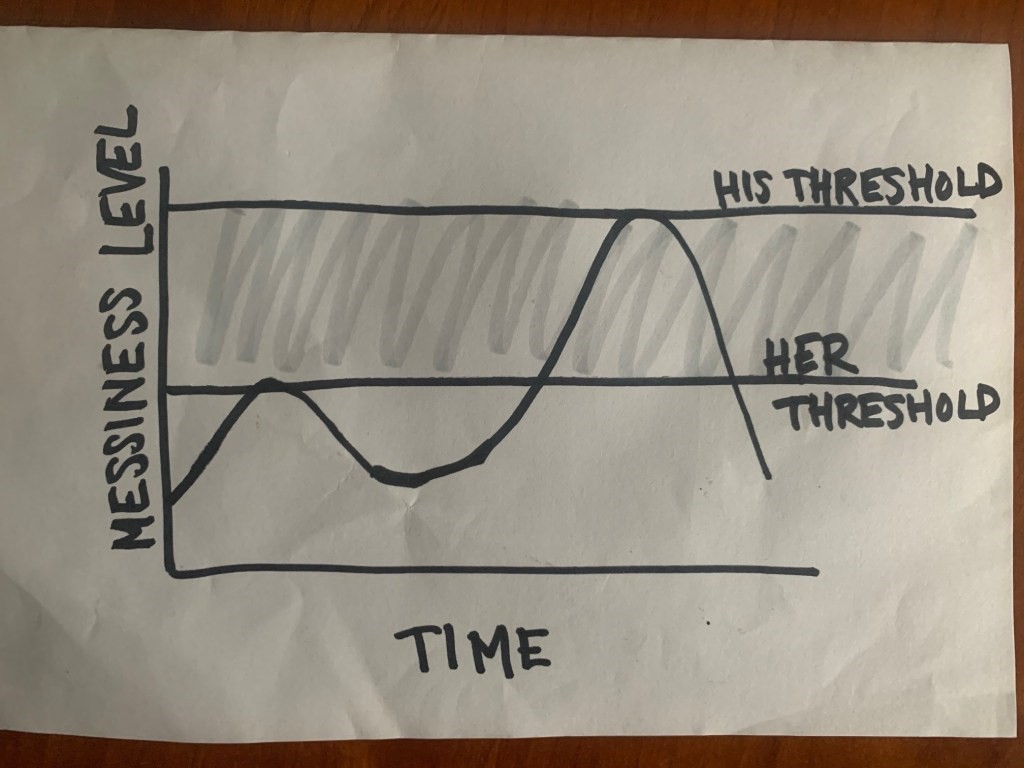
Since I am six years younger and wasn’t married at the time he told me, I thought he was imparting some great wisdom about marriage. It wasn’t til later that I realized that his diagram depicted a way of looking at all our relationships.
Because our thresholds on any number of subjects will likely vary in a great number of areas from those around us: what qualifies as noise, when do we experience hunger, pain tolerance, ability to withstand uncertainty, desire to take risks, and our willingness to express ourselves or seek relief when we are exhausted, overwhelmed and sad to name just a few. So how do we live with others in the gray area between our tolerance level and theirs?
Believe Them
My years as a parent of young kids have taught me that it goes better when I believe them when they tell me how they feel. In that way, we don’t end up debating the truth of the feeling but instead can move to finding out what to do about it.
There are times they’ll tell me they are sad, frustrated, disappointed and I might say, “It’ll be okay” if we need to move on. But I try not to argue that they should be feeling something else like grateful, happy or blessed because it compounds the feeling. They stay stuck trying to prove what they are feeling instead of transitioning to the next phase of how to make it better.
Try to Laugh About It
The other day my 7-year-old daughter was goofing around before bed. Despite my numerous admonitions that she was too tired to keep safely doing cartwheels and should instead try to quiet her body, she kept throwing herself around the room until she ended up hurting her arm pit and her crotch. At that moment, I had the choice of being irritated that she didn’t listen or making a joke about those being two very unlikely body parts to get hurt at the same time. We ended up laughing all the way to bed about how that happened.
On a recent Unlocking Us podcast with Brené Brown, Drs. John and Julie Gottman were talking about their latest book, The Love Prescription: Seven Days to More Intimacy, Connection and Joy. They made the distinction between turning toward a bid of attention (responding or engaging when your partner says something like “look at that blue jay out the window”), turning away (ignoring) and turning against (responding with something like “why are you interrupting me?”).
In happy relationships, people turn toward their partner’s bids for attention 86% of the time, couples who were not successful only turn toward each other 33% of the time. John Gottman explained the result, “Couples who increase their turning toward wind up having more of a sense of humor about themselves when they are disagreeing with one another, when they are in conflict.”
As Brené Brown summarized “Turning toward gives us a sense of confidence about our togetherness.” From there, it’s easier to find what’s funny about this daily existence.
Live Directly
In his book, The Book of Awakening, Mark Nepo gives an example of being at an ice cream shop with a friend and eating their cones when the table next to them became boisterous. As he became more irritated, he asked if she wanted to go. But his friend was fine and in saying so, she noticed the look on his face and asked, “Do you want to go?”
He laughed as he realized he was couching his needs into some form of thoughtfulness instead of owning his own feelings. Relationships are so much easier when we claim our own stuff and live directly.
Navigating the Gray Area
My brother’s marriage from his 20’s, the source of the threshold theory, didn’t work out. Turns out his wife had a different standard for telling the truth about significant things. I suppose there needs to be another line on the chart for boundaries. Regardless, I learned a lot vicariously about living in the gray area with others. The longer I live, the more gray it gets but also easier to navigate if I believe others, laugh about it and own my own stuff.
I’ve written a companion piece to this one on the Wise & Shine blog about WordPress relationships: Do You Like My Writing or Are We Just Friends?
(featured photo is mine – a heart of the week from Whidbey Island)
 Surprised By Joy
Very thoughtful and wise. The size of the gray areas and the number of them surely are a test. Nor are they static, a particular challenging in long relationships whether platonic or otherwise. Thanks for writing about this, Wynne!
LikeLiked by 4 people
Truly, these grey areas are the very things we learn and grow the most from, for everyone is different from us (not a bad thing) and by assuming people feel and respond to things the way we do is to eliminate a lot of opportunities for growth.
I also love “They stay stuck trying to prove what they are feeling instead of transitioning to the next phase of how to make it better.” I’ve observed this is true of adults too!
LikeLiked by 3 people
“assuming people feel and respond to things the way we do is to eliminate a lot of opportunities for growth.” Brilliantly said, Tamara. And I totally agree that adults get stuck in proving emotions too.
LikeLike
This seems to be underlying for many outbursts!
LikeLike
I love that point — a measuring stick, for sure – oh-so dynamic in relationships, generally. Thanks, Dr. Stein…and Wynne! 😉
LikeLiked by 1 person
A measuring stick – love that image, dear Vicki!!
LikeLiked by 1 person
Ah, thanks for adding this delightful perspective, Dr. Stein. Surely are a test and also changing. Right!!
LikeLike
This post is incredible, and the timing of my reading it ALSO incredible!
I’d just posted something that fits in with this threshold theory (on communication needs, specifically) before I toggled over to my reader feed and saw this atop it. I already knew I was in the right place when I saw the graph, but then each word thereafter really hit the heart of it all further home for me.
Lots and lots of great food for thought (and future drawing-on, in future cross-domain “different-thresholds” moments, thank you. My heart is so full. ❤
LikeLiked by 2 people
I love this synchronicity you describe, Deb! And of course your whole-hearted comments. Different thresholds – a good thing to be on the lookout for!
LikeLiked by 1 person
We must be on the same wavelength. I sensed the Gottman vibes on your companion piece, and here we are!
Navigating that grey area is something I don’t often hear talked about, but it’s such a valuable skill to learn. As you highlight, there are layers to it, but it becomes so much easier when we trust others’ experiences, find the humor, and learn to be transparent about where we are.
LikeLiked by 1 person
Ha – love the same wavelength. I read your other comment and loved how you brought the Gottman’s to that subject. Great minds, Erin…! 🙂
LikeLiked by 1 person
Turning towards and laughing, love the cartwheel example.
LikeLiked by 1 person
Your comment is making me laugh about that all over again. Holy smokes… 🙂
LikeLiked by 1 person
Your brother’s story about cleanliness and thresholds is so true. I like an empty sink. My husband likes to put dishes in the dishwasher at the end of the day. I am continually walking into the kitchen emptying the sink…
LikeLiked by 1 person
Oh, I’m giggling about your sink, Elizabeth. It illustrates many things but certainly the work-from-home scenario as one. If your husband worked at an office, would he still wait until the end of the day? We are all so interesting, aren’t we?
LikeLiked by 1 person
I was thinking that is one of the hazards of working remotely, too. If he was in an office, he wouldn’t be making dirty dishes all day long!
LikeLiked by 1 person
Hee, hee, hee! 🙂
LikeLike
In my circles, we use the word “attunement” a good deal. I’m finding that without attunement, we don’t have much empathy for the other, and without empathy, we don’t have much room for meaningful relationship. So, I’m practicing attunement.
LikeLiked by 1 person
Attunement – I like that word. It seems to especially fit well with your musical talent.
LikeLiked by 1 person
You’re right in saying that the gray area exists in most relationships over a myriad topics. Learning to navigate them effectively is where we grow in our relationships because that gray area has the potential for greater conflict.
Great sailors are the ones who’ve navigated a few storms.
Great post Wynne. And such a wise brother. So he got it from you? Or the other way around? 😂
I’ll read the other post later this evening. Can’t wait.
LikeLiked by 1 person
I love your point about navigating the gray areas is where we grow our relationships. Beautiful observation and you’ve said it so well! And I’m smiling about the comment about my brother. I think my dad did a good job of passing on his wisdom to the degree that kids can pick that up… 🙂
LikeLiked by 1 person
Your dad was a wise man Wynne. And funny too. Win/win. Maybe that’s why you’re named Wynne. 😂
LikeLiked by 1 person
Ha, ha, ha!!
LikeLike
I’m going to have to start taking notes. I especially loved the Mark Nero story and your reminder to clam our stuff. His ice cream story. Oh, yea, I’ve definitely done that, pushed my feelings off onto others. You’re so right, it’s so much better when we own our thoughts and feelings. Thank you!!
LikeLiked by 1 person
I’ve done that ice cream thing many times too. As they say, “write what you need to read” and that is so true in my case! Thanks for reading, Brian!
LikeLiked by 1 person
All young couples need to be taught this threshold image….it may save many upcoming misunderstandings! 💞💞💞
LikeLiked by 1 person
Right, Dawn! Somehow the visual makes it more clear… 🙂
LikeLiked by 1 person
So many excellent points in this, Wynne—but I got caught up in a great giggle about getting hurt in two unlikely body part at the same time. Talk about leaning in. Great example, good job! 💕
LikeLiked by 1 person
Ah, now I’m laughing all over again, Julia! Thank you, my friend!
LikeLike
Great post with a lot of wisdom imparted.
LikeLiked by 1 person
Thanks, Susan!!
LikeLiked by 1 person
I agree with Lori Gordon, and I wish more young people thought about this – “Love is a feeling, marriage is a contract, and relationships are work.”
LikeLiked by 1 person
Sometimes all of that is a blur when we are in a hurry to get to forever, huh? 🙂
LikeLike
I remember this post and the diagram your brother drew!
You make a good point about how learning to navigate and coexist in this shared gray area is the key for longterm relationship success.
I can think of many ways to graph this threshold chart – dishes, laundry, doing reading with T, and the list goes on. I agree that if we don’t learn to work together and find that balance, then it simply won’t work out.
Now to impart this wisdom onto our kids!
LikeLiked by 1 person
Oh, I’m laughing about how to impart this lesson to our kids. Geez, I’m not even sure their seemingly infinite ability to ignore clothes on the floor and mess all around even makes it on the chart. But, as always, you’re right – that’s what we are working towards. Hopefully we get there sooner or later… 🙂
LikeLiked by 1 person
I think ending the evening with a sore crotch and armpit sounds pretty stimulating at my age.
LikeLiked by 2 people
I’m chuckling. No response comes to mind but I’m chuckling…
LikeLiked by 1 person
Jay is a genius. Quite funny about Miss O’s bizarre injury. Poor thing. Glad you could get her to laugh. And by the way, when I was picking up my books off the library hold shelf, the one on hold next to my stack was: The Man’s Guide to Women by the Drs. Gottman. I thought of you. 🙂
LikeLiked by 1 person
That sounds like an interesting Gottman book! I’ll tell Jay that you appreciate his genius – I know he’ll appreciate that! I love that you’ve met him too. So grateful that you all came up here!! ❤ ❤ ❤
LikeLiked by 1 person
Me too! I now know these people of whom you speak! I saw Eric in a pic you took at a baseball game and was like, “Hey, I know that guy!” 🙂
LikeLiked by 1 person
It’s so fun!! ❤ ❤ ❤
LikeLike
After our podcast today, and Vicki’s dishwasher training, this seems extremely relevant! I really like the idea of different thresholds for all things. It makes so much sense, and it appears to be an argument for compassion with one another, but then of course there is this tendency to make my line morally superior to his! It happens. Hugs to Miss O and a shout our to Mark Petruska for his hysterical comment! Loved being with you and Vicki today. Hugs, C
LikeLiked by 1 person
I love how you tied this to the dishwasher training – right! I loved our conversation today – there is something that feels so refreshing and revitalizing to me to get to talk and laugh with you and Vicki (even when being recorded) and sharing wisdom, questions, and choices. It’s what the best conversations should hold and I love your ability to bring that. Sending big hugs to you, dear Cheryl!
LikeLike