“It never hurts to see the good in someone. They often act better because of it.” Nelson Mandela
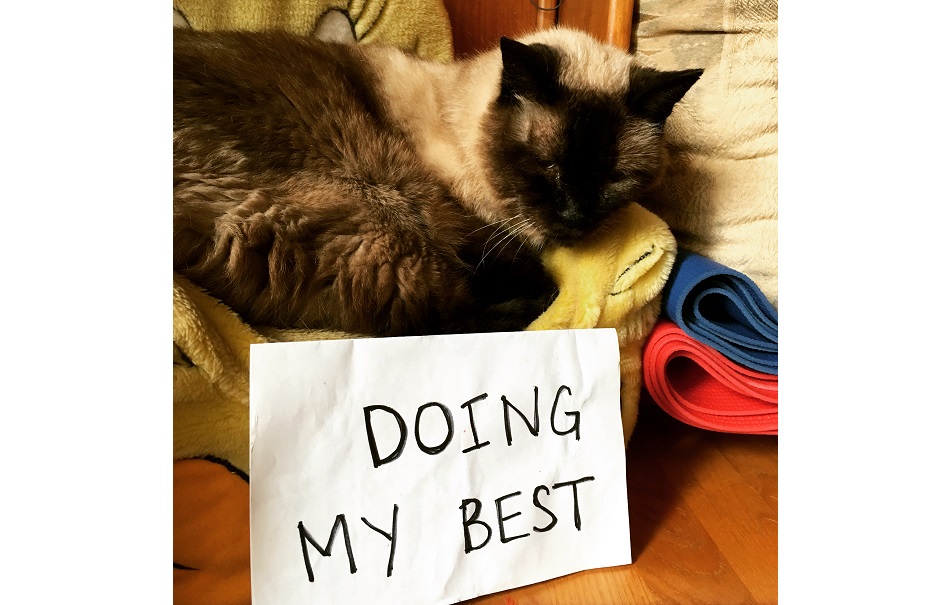
I used to have this cat, Simon. He was a Siamese mix that I inherited from a neighbor when she went to study in Hawaii for two years. She moved back from Hawaii but never returned for the cat. I suspect it was because he was a bad boy. He’d break into other people’s houses, he’d fight with other cats, he’d get locked in places like neighbor’s garages that he should have never been in the first place. A classic Simon story was that I had a neighbor, Steve, who hated Simon because he was always getting into his stuff. Steve lived in a duplex and when someone new moved into the other apartment, he was showing them around the basement with the washer/dryer the two units shared. As he was saying to them, “The most important thing is that you can never leave this door open because there is a cat that likes to come in here.” The new people asked what he looked like and as Steve replied they interrupted, “Like that cat right there?” And right behind Steve’s shoulder was Simon sitting up on a shelf smugly looking at them all.
Simon was so smart with such a big attitude that he was very amusing. He’d walk with me and my dog for 12 blocks, always looking around like he was the secret service agent keeping us safe. He was a snuggler too. Whenever he bothered to come home, he’d climb right into my lap and collapse there. But when push came to shove around his bad behavior, I’d always distance myself from him, “Oh yeah, that’s a cat that I inherited.” Like I did at the very top of this story. His bad behavior was disrespectful and rude, two things that I don’t see myself as so I think I just couldn’t own up to him.
I’m thinking of this because my five-year-old daughter this morning told me that she got in trouble yesterday when she and her friend were at the park with her friend’s caregiver. They went to an area that they were told not to go in order to climb trees. I assume that this was a pretty mild incident given that I heard about it from my child a day later and not the caregiver or the other parents. But it was notice that I’m crossing the threshold of parenting where my child can make choices outside of my control and supervision. And it raises the question about how to manage the myriad of feelings that come with it, specifically the judgment that comes with it – my judgment of my child and my fear of judgment by others.
There are two examples that come to mind about parental reactions to bad behavior. The first is a notable case from when I was growing up about a prominent family in the town. The dad was the editor of the newspaper, the son, who was then in his 30’s, got arrested for serial rape and the mom tried to bribe the judge and have the prosecutor killed.
The second story is on the other end of the parental spectrum and is a video that I saw a dad had posted online of his daughter running to school. He had posted it to shame his daughter for lying about what had happened to her bike.
Between those two examples is probably where most parents operate, I hope. I am finding that I am at my best when I let go of my judgment and instead choose discernment. When I am judging my child’s behavior, I feel the constriction of my viewpoint into not only what have they done but also who that means they are. Even when I don’t say half of what I’m thinking because I’ve declared that there will be no name calling in my house because the research that shows shame does not work, my thoughts jump to judgment. But when I am able to move through that into discernment, I can feel myself open back into curiosity. Both about how to best teach the values that I think will be most helpful and also about what conclusions/lessons my child has already learned before I even say anything. Crossing between judgment and discernment requires at least one deep breath.
So I asked my daughter why she thought that area of the park was out of bounds and what she might do differently the next time she’s invited. She had pretty good answers and we talked through the gray areas. It was better than anything I could have lectured on my own.
Postscript: After many different types of behavioral intervention for Simon and one time when he died and had to be resuscitated on the operating table as he was getting another cat’s tooth extracted from his back after fighting, the vet finally prescribed some kitty Prozac for him. He stopped fighting and breaking into other’s houses and he lived to 19 years of age. He lived with me for 14 of those years so I guess he was my cat after all.
 Surprised By Joy
Great way to raise a child to talk about it. It allows all parties to see each other’s perspective. Talking also helps your child communicate better, and develop her critical thinking skills.
LikeLiked by 1 person
Love getting your professional opinion on this. I suspect that method was a great part of your education and now your job!
LikeLiked by 1 person